Episode 27 - Wherever I May Roam
Those of us who like to spread dandruff worship at the altar of a truly broad church. From the UK to Uzbekistan, the USA, Uganda, Ukraine (which may be part of Russia before we’ve finished writing this) and Uruguay, the compulsion to shred reaches all four … er … corners of this diverse globe.
And if you haven’t yet wrapped your ears around Ugandan, Ukranian, Uzbekistanian or Uruguayan metal then you obviously haven’t treated yourself to, respectively, any Vale of Amonith, Adem, Montfaucon or Alvacast.
And neither have we. We know they’re out there, but we haven’t quite summoned the courage to listen. Why? Well, it’s because we’re old men now and our appetite for adventure rarely extends much beyond the vague curiosity that comes from trying to conjure an erection.
But we digress. The point is that it’s the very fact we’re old men that when the Tico Torres Tombola of Topics and themes spat out the coloured ball that correlated to the theme of Wherever I May Roam and an instruction to find an album or band named after a place, the likes of Kampala, Kiev, Montevideo and Tashkent weren’t exactly top of our metal list.
Though having said that, Steve - who has been known to stretch the elastic of these topics to (and perhaps beyond) breaking point from time to time - did manage to choose a city that was abandoned in 1000AD - around the same time as Sweyn Forkbeard was pronounced King of England. And no, we haven’t lifted that from Game of Thrones. Never say the Enter Sadmen podcast isn’t educational.
In fact, Steve and Richard ended up a mere 950 miles away from one another. But anyone who’s fearing the worst at this stage need worry no further. Mark kept the rock and roll dream alive by heading to the drug and extortion capital of France.
All things considered, it was promising to be an interesting chat.
Nazareth - Hair Of The Dog (1975)
Ah yes, Nazareth. The childhood home of Jesus Christ and biblical centre of the Christian world. Wander down the narrow wall-lined Al-Bishara Street and you’ll pass St Joseph’s Church, said to have been built on the site of the carpentry workshop owned by Jesus’s … well, how would you describe him? Um, step-dad? Anyway, least said, soonest mended and all that.
Eight doors further down this twisting turning road and the imposing facade of the Basilica of the Annunciation rises into view; the site where, it’s said, Gabriel appeared to Mary and casually dropped the small matter of her impending immaculate conception into conversation over a cup of tea and a Belgian bun.
Okay, maybe the accuracy of one or two elements of that story is questionable. But what isn’t in question is the fact that to a group of feisty young men growing up in Dunfermline in the early 1970s, the domed churches, sandstone architecture, and sultry geopoliticism of the Arab capital of Israel would certainly have commanded a level of mystique that marginally trumped the view over the Forth Bridge to Scotland’s capital city.
Well, what would you choose to call your hard rocking band given the choice between two towns whose respective claims to fame are being the home of Jesus Christ and being the home of the world’s longest cantilever bridge? Exactly. No contest.
But Hair Of The Dog does rock along at a fair old lick, and in this episode you can also learn the background to the album title and why Mark was disappointed to discover that My White Bicycle, Nazareth’s biggest single of 1975 - and one he bought with his pocket money - wasn’t on the album (that he also bought with his pocket money).
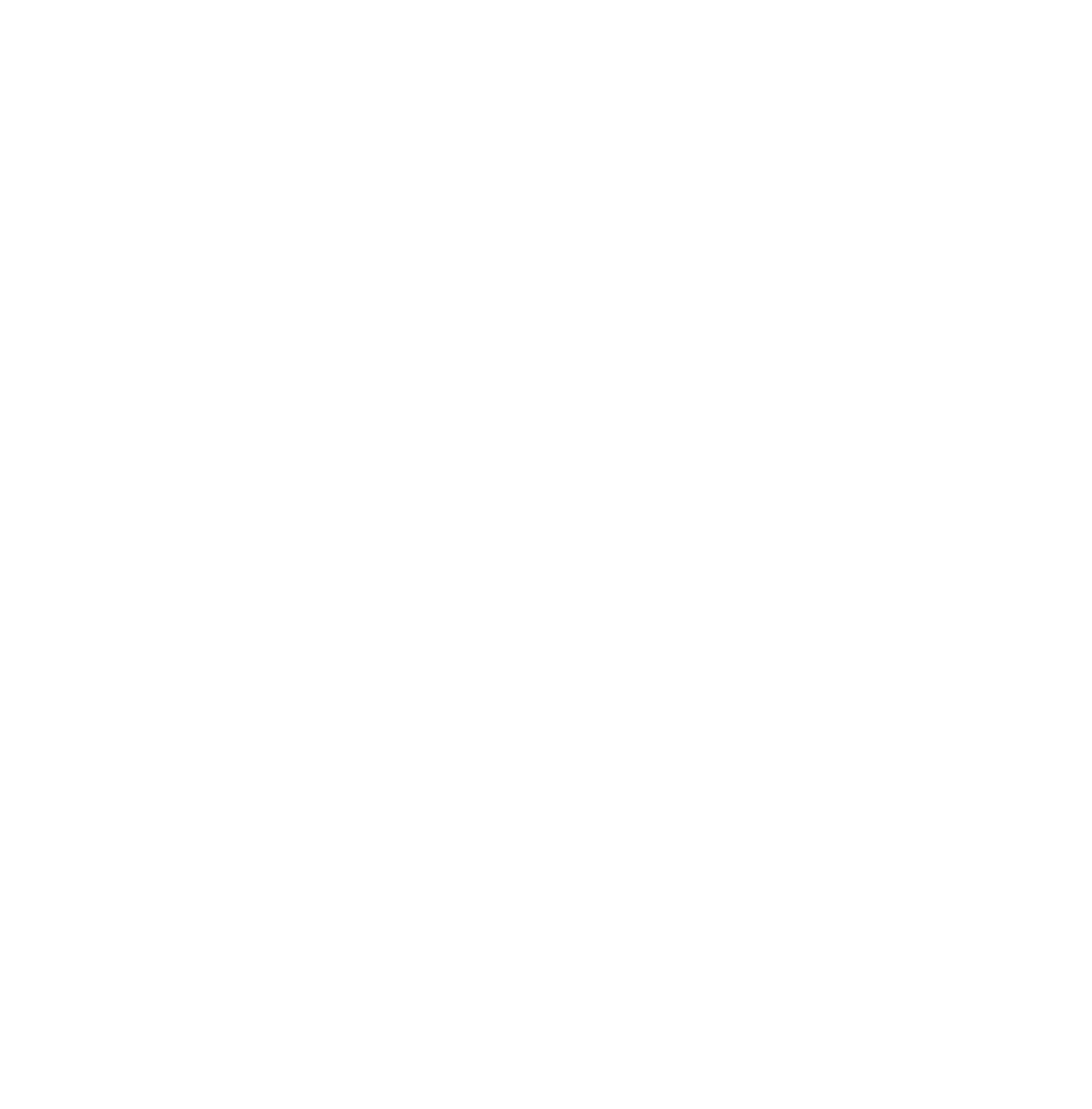
Marseille - Touch The Night (1984)
Utter the name Marseille in a social gathering and you’ll doubtless evoke three images. The first is likely to feature a 1962 Ferrari California Spider streaking around the sunwashed roads of the French Riviera high above the azure waters of the Med, Brigitte Bardot at the wheel, headscarf flying in the warm turbulent air; The second will likely be sun-drenched beaches, cocktails in high-end promenade bars, and the glitterati out in full force, sporting Armani swimming trunks and Gucci flip flops; the third will be Gene Hackman in a pork pie hat, chasing down drug smugglers as he careens beneath the bridges and piers of the heroin-smuggling capital of Europe.
It was the last of these that drew the attention of three lads from Liverpool, England in 1976 who found themselves looking for a new name for their band, having had the unlikely misfortune, in their first stab at the task, to plump for AC/DC. Because surely there’d never be a chance of another band coming up with the same bright idea, right?
Misfortune, though, always seemed to be within dogged nipping distance of the heels of the newly-monikered Marseille. Having won the inaugural UK Battle Of The Bands at Wembley in 1977, and securing a contract with the Mountain label to record their debut Red White and Slightly Blue in 1978, their star appeared to be in the ascendency.
They quickly became the first New Wave of British Heavy Metal band to play a major overseas festival, supporting the mighty Cheap Trick (who themselves were midway through their all-conquering Heaven Tonight tour, which would culminate in the hysteria-fuelled 1978 live album At Budokan).
Support slots followed by the lorry load. Whitesnake, UFO, Judas Priest and, by happy coincidence, so far as this edition of the podcast is concerned at least, Nazareth, to name but a few. So enamoured by the Liverpool lads was Nazareth guitarist Manny Charlton that he stepped up to record the band’s second album, the self-titled Marseille, the subject of this edition of the Enter Sadmen podcast.
Sadly, Marseille’s hooky, melodic hard rock formula that gave them column inches in the likes of Sounds in the UK alongside the likes of Saxon, Maiden and Def Leppard, and should have set them on their upward trajectory, wasn’t enough to see them break through the NWOBHM glass ceiling.
And why? Remember we said that misfortune constantly nipped at the heels of the band? Well, eventually that nipping turned into a full-blown savaging.
Not long after the album’s release, the Marseille embarked on a tour of America. It was relatively successful and should have been the launch pad for greater success. But when the band returned to the UK they discovered that in their absence, the Mountain label had quietly folded into oblivion.
That, in and of itself, was not insurmountable, right? Pick yourself up, dust yourself down, find a new label, and go again. The kicker, though, was that the band’s gear was still at the airport waiting to be freighted home - the cost of which should have been met by a label that was now drowning in debt and whose carcasss was being picked over by a string of creditors.
With Mountain having gone to Muhammad and the band having no financial means themselves to retrieve their kit, what had seemed to be a bright future suddenly dimmed to darkness in two years of litigation and misery which saw two of the three founding members leave and pursue more stable sources of income.
All of which was a great shame, for two reasons. First, because somehow it seems more cruel to have felt your fingers brush the kind of success that awaited Iron Maiden and Def Leppard than to have never stood a chance at all. And second, because - as the Sad Men were about to find out - Marseille well and truly rocked.
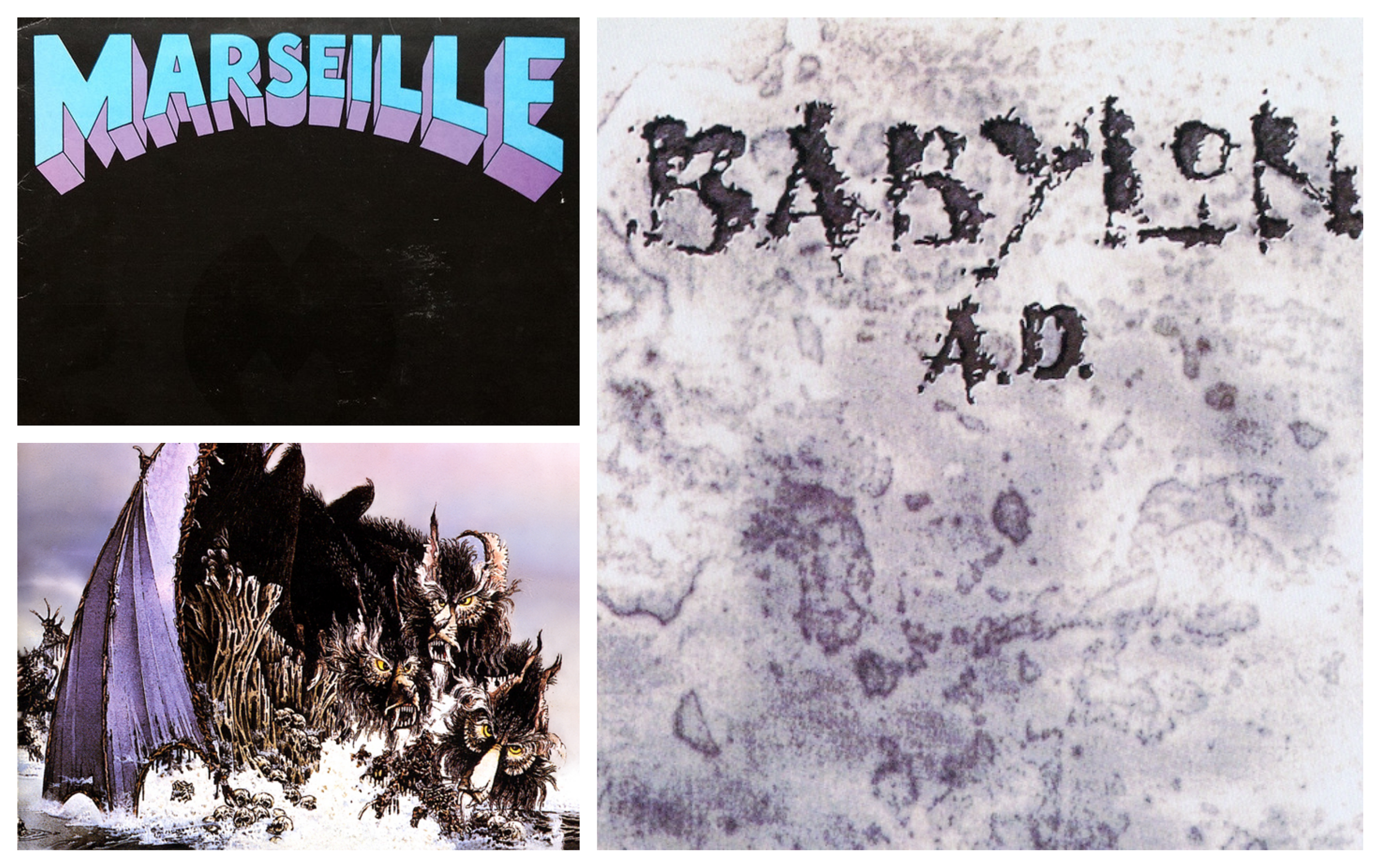
Babylon A.D. - Babylon A.D (1989)
And so Steve decided the pod should head to Mesopotamia (modern day Iraq, for those of us unfamiliar with the classics) and the ancient city of Babylon on the banks of the Euphrates. Known for its Hanging Gardens - one of the ancient Seven Wonders - and declared a UNESCO World Hreitage Site in 2019, the city also gave us the modern 60-minute hour. Like we keep saying, don’t say the pod isn’t a source of education as well as loud music.
Actually, back up a moment there. Apparently, there’s no archaeological evidence that the Hanging Gardens of Babylon ever existed in the city and were more likely sited in the neighbouring city of Nineveh. Meaning Babylon may well have been credited these past millennia with something that was never there.
Not that such things were occupying the minds of five lads from the Bay Area of San Franscisco back in 1987 when they formed Babylon A.D. Unleashed on the burgeoning hair metal scene, the band quickly set to work on exploiting a niche market amid the fog of hairspray and indistinghishable by-numbers song composition that made up much of the hair metal half-decade hellride into 1991, when grunge put a stop to the nonsense.
With Derek Davis’s assured vocals and Dan De La Raso and Ron Freschi’s ear a capable duo handling the guitar work, the band found themselves trend-adjacent from the very start. Over the years, a stream of soundalikes would spee forth from the A&R offices of the major labels as they scrambled to find the hot new ticket in town.
Many of them melted away as quickly as a dusty covering of early spring snow, yet Babylon A.D seemed somehow different. More substantial. In a hard rock and heavy metal yearbook, they were the band that would have been voted ‘Most Likely to Make the Big Time’.
Yet for all the pomp and gloty of this, their 1989 debut album for Arista, and much like Marseille, what should have been theirs never really materialised. A second album, Nothing Sacred, followed three years later, and the band toured heavily well into the Nineties, but fans had to wait another eight long years before another release - American Blitzkrieg - found its way into stores in 2000 courtesy of their own Apocalypse Records label.
By then, of course, the jig was up. No one outside the band’s core fanbase really remembered, or much cared, for that matter, who Babylon A.D. were or had been. And though the band continues to record and tour today, only Davis and Freschi remain from the original line up that delivered this prime slice of West Coast metal.
There’s a certain self-deprecatring irony in the title of their 2024 album - Rome Wasn’t Built In A Day … because neither were babylon A.D. Sadly, they weren’t built in 37 years, either - which is a great shame, because truth be told - they were pretty damn good in their time.